Seeker Envelope looks like a community chat with a red-envelope button. That isn't the product. The product is the loop underneath: discover a group, complete an action, earn points, spend or stake them, collect cards and turn participation into voting power.
I'm Juan Torchia, a software architect and full-stack developer. I tested that loop the way I'd review a production integration: follow state before and after each action, separate a UI promise from a settled result, and stop where authority or asset movement changes.
That matters here. The same interface connects social tasks, points-based predictions, swaps, gated rewards and packs that may contain rights to future tokens rather than tokens delivered today. The loop is ambitious. Its boundaries deserve the same attention as its rewards.
My thesis is narrower than "many features in one app": Seeker Envelope earns trust when one action produces a state the next screen can explain. It loses trust when the reward is visible but the proof, cost or settlement rule sits one click deeper. The most useful test wasn't the largest number on screen. It was whether the arithmetic and receipts closed across Predictions, Spin, Missions and Profile.
Disclosure: I prepared this independent, transaction-free interface review for a paid Pump.fun writing bounty. A reward depends on acceptance; I have received no payment, product consideration or referral benefit. Observations and changing interface counts are dated August 24, 2026.
I inspected the public and wallet-connected surfaces with a test wallet already loaded in my browser. I placed two predictions using 11 of the free internal points available to the account and used one free spin, but stopped before signing a transaction, opening a pack or claiming a reward. This review proves those entry flows and what the wider interface displayed—not settlement, fulfillment or payout.
Official app: https://envelope.emostically.com
One interface, several participation loops
In practice, it is a community hub where chat activity and wallet-connected actions feed points, rewards, collections and voting. A user can discover a group, complete missions, earn points and use those points in other features. Some rooms advertise token thresholds, so access can be open or token-gated.
Red Envelopes and Drops
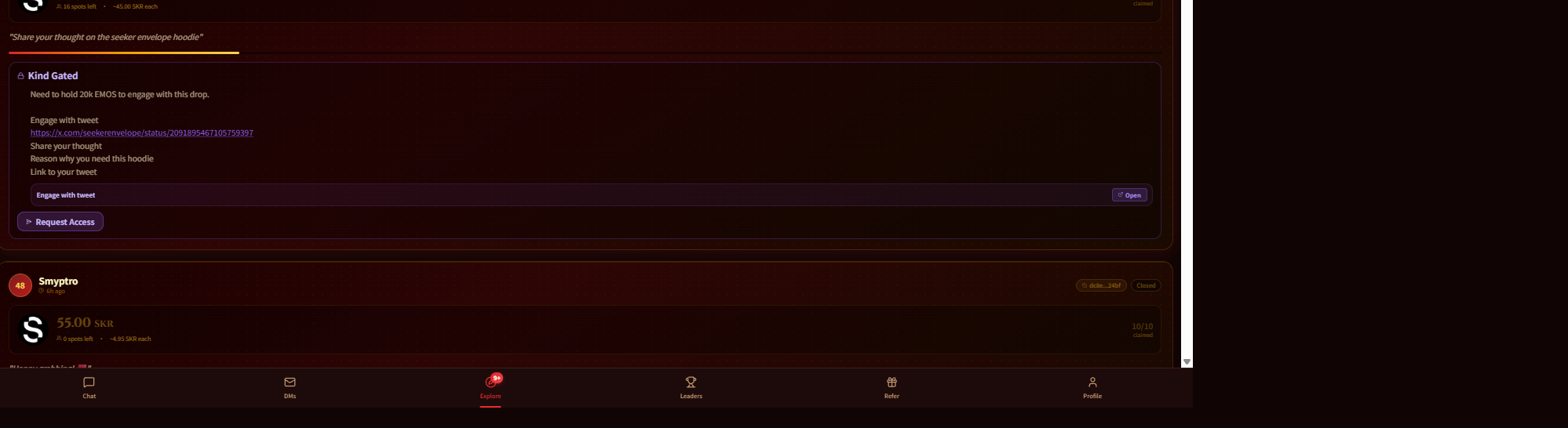
In the interface I reviewed, Drops acted as the discovery feed for envelope distributions. A card can show its total reward, spots, estimated share, claim count and instructions. On August 24, 2026, the feed showed 18 active drops.
Not every drop is first-click-first-served. One live example was Kind Gated:
it required holding 20,000 EMOS, engaging with an X post, explaining why the
user wanted the reward and supplying a link before requesting access. This
design supports giveaways and proof-of-engagement campaigns, but users
need to read the conditions before acting.
Profile separately tracks pending Seeker received from envelopes and links to a user's own envelopes. I did not create, request access to or claim an envelope, so this review verifies the discovery and eligibility screens—not fulfillment.
Missions make the product map explicit
In my session, Missions appeared empty before wallet connection and populated afterward. I could not determine whether that was intentional gating or data hydration, but the populated board clearly mapped the ecosystem.
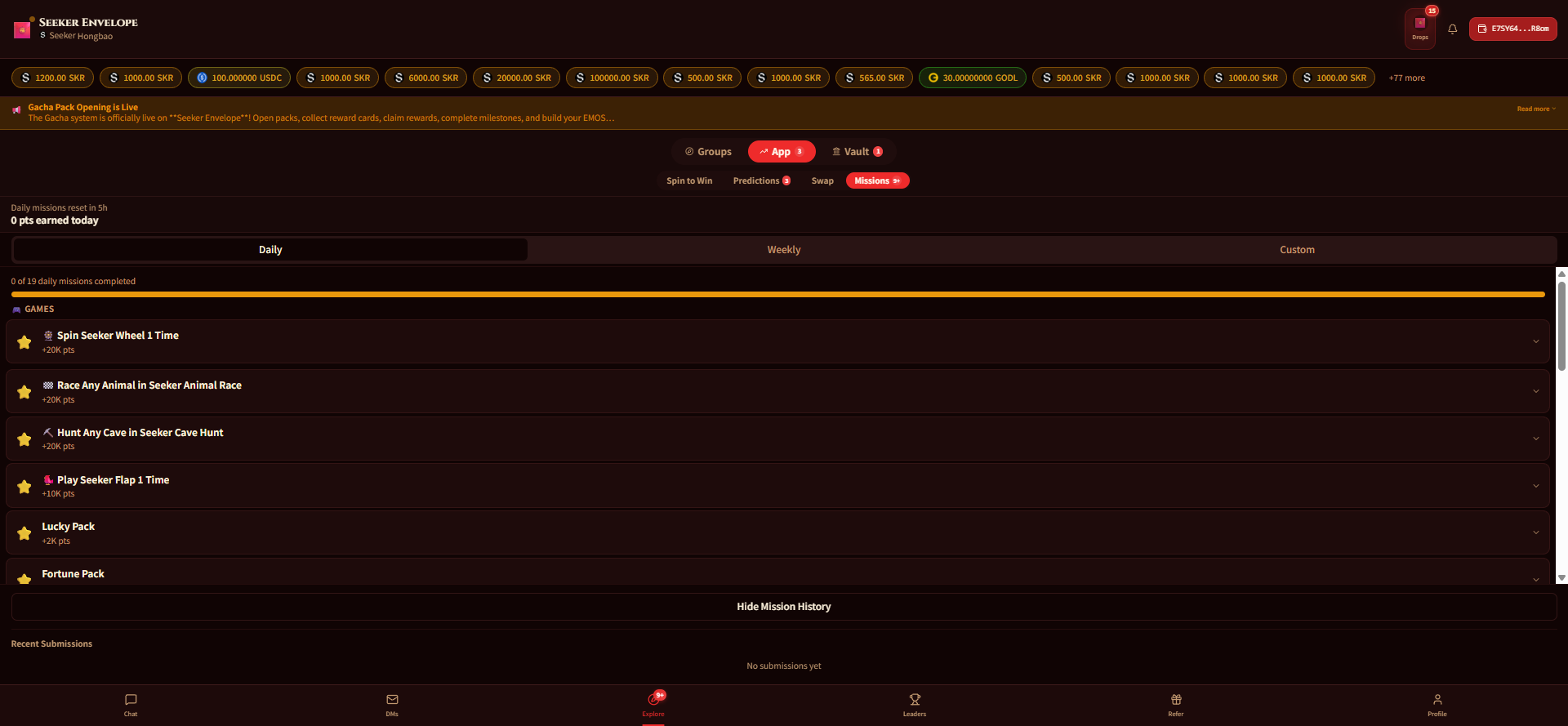
The board is divided into Daily, Weekly and Custom missions. I saw 19 daily tasks across four activity types:
- Ecosystem games offered 10,000 or 20,000 points per task.
- Opening packs offered between 2,000 and 300,000 points.
- Swap missions started at USD 5 and progressed through USD 20, 50 and 100.
- Creating a red envelope offered 10,000 points; grabbing one offered 1,000.
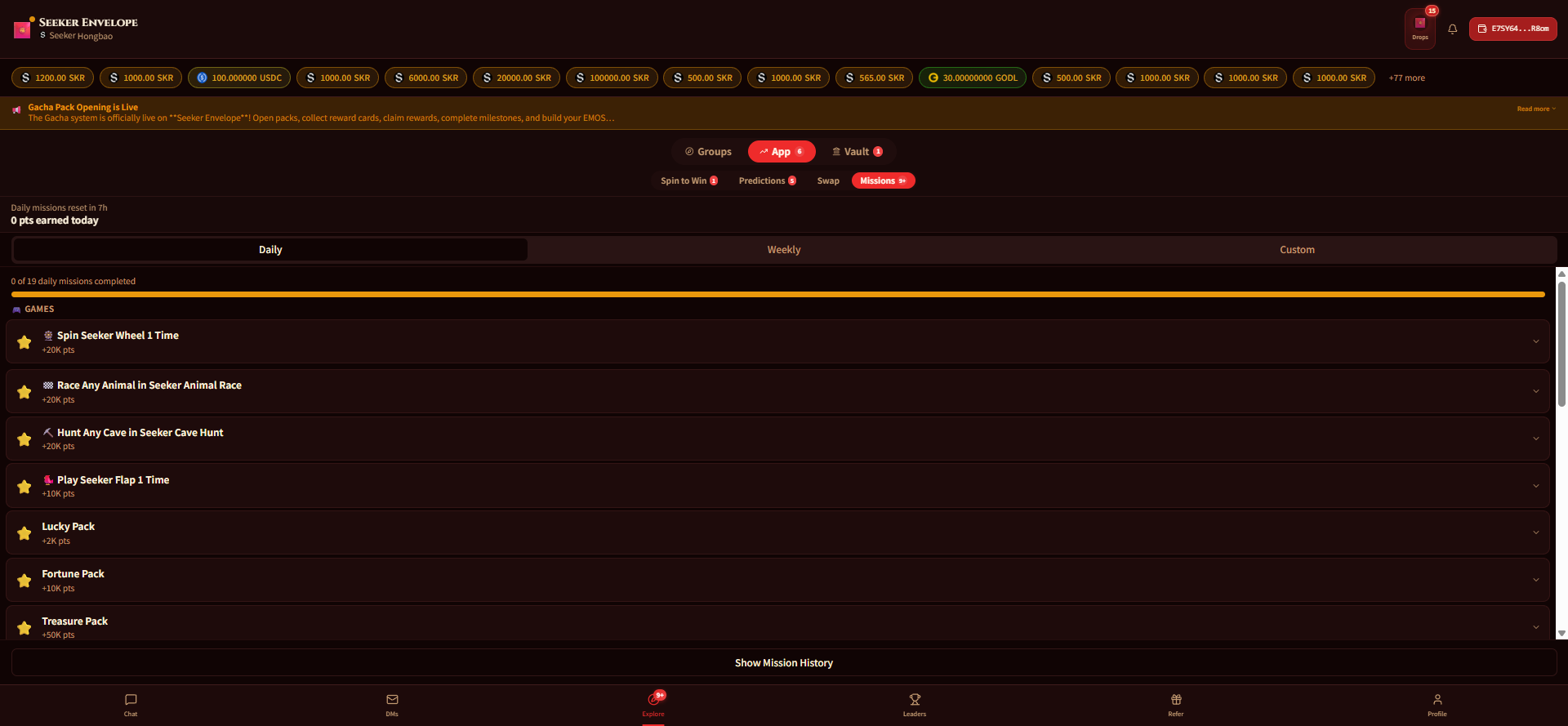
This works as an onboarding map because it routes users through actual features. The trade-off is visible too: many high-value missions require spending, swapping or opening a pack. Points are incentives, not proof that an action is economically worthwhile.
Swap: convenient, but read the fee line
The embedded swap defaults to SKR and USDC and identifies Jupiter Aggregator as its provider. The captured Swap panel disclosed a 0.5% platform fee, while its slippage tolerance was set to 0.5% during my review.
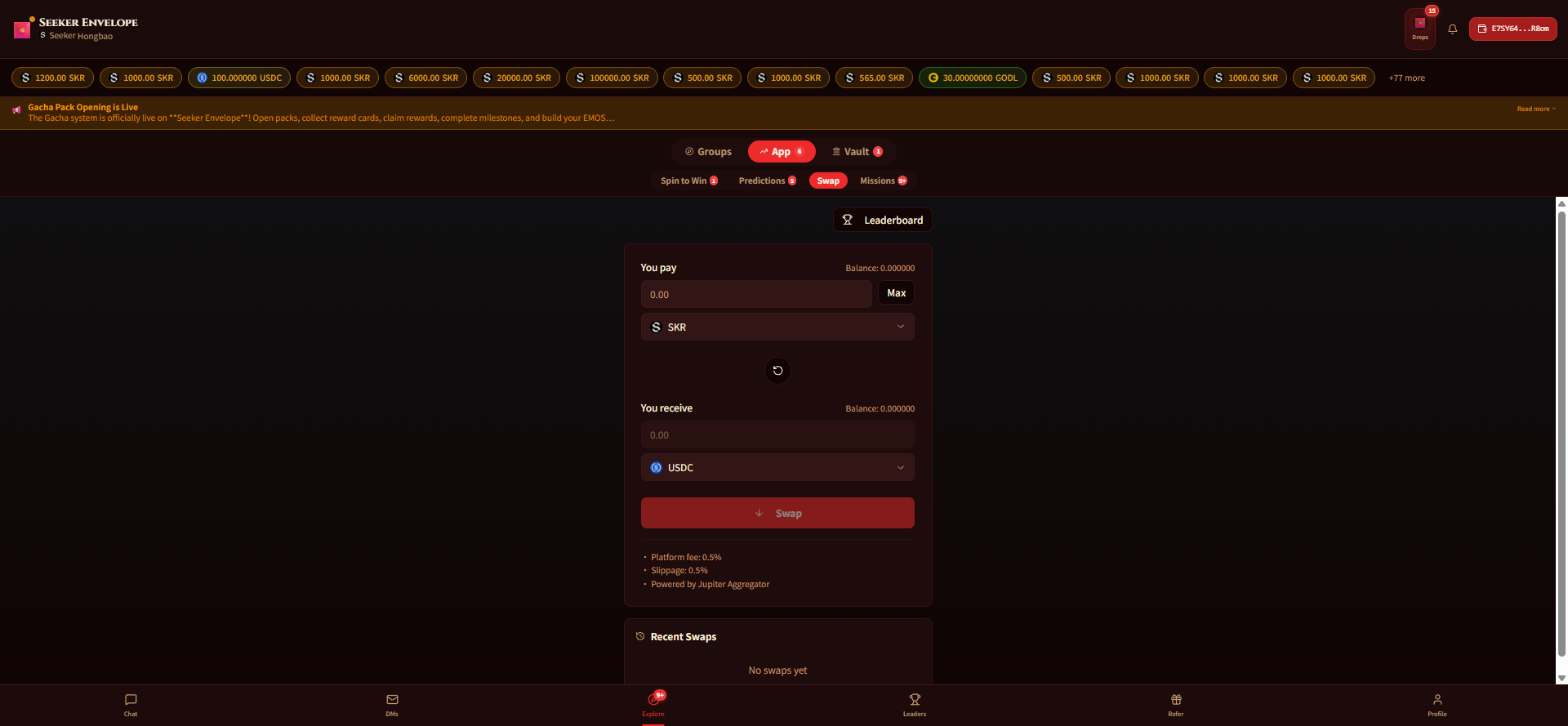
The test wallet had no SKR or USDC, so I did not request or sign an exchange. Even without executing one, the relationship is clear: Swap gives users an in-app bridge between assets, while Missions rewards volume at increasingly large thresholds. A careful user should evaluate the quote, price impact, network cost and mission reward separately before trading.
Prediction Markets use points
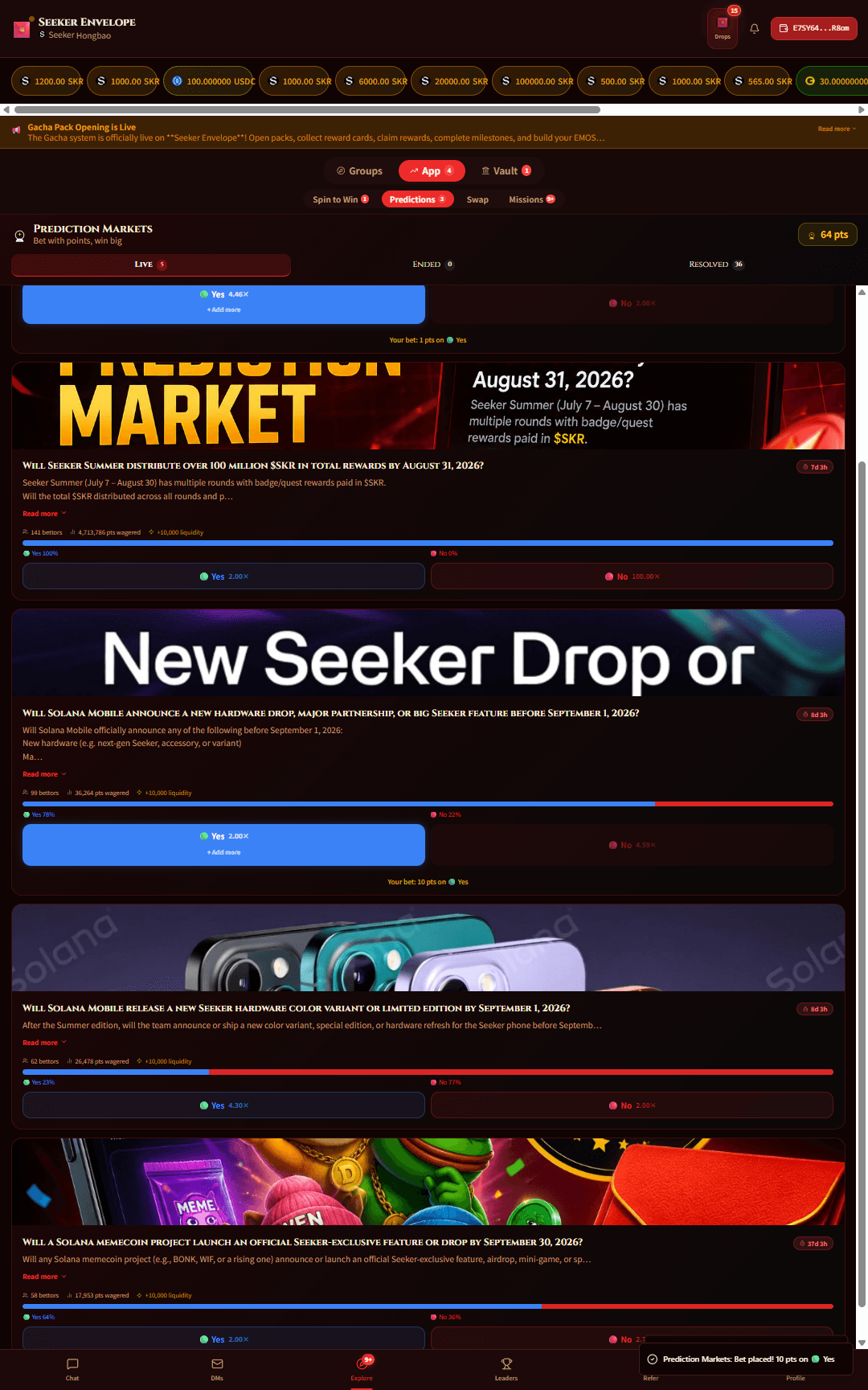
In my session, Prediction Markets populated after wallet connection. The screen showed five live and 36 resolved markets on August 24, 2026. Each live card included a deadline, bettor count, points wagered, added liquidity, Yes/No percentages and potential multipliers. One visible market had 141 bettors and more than 4.7 million points wagered.
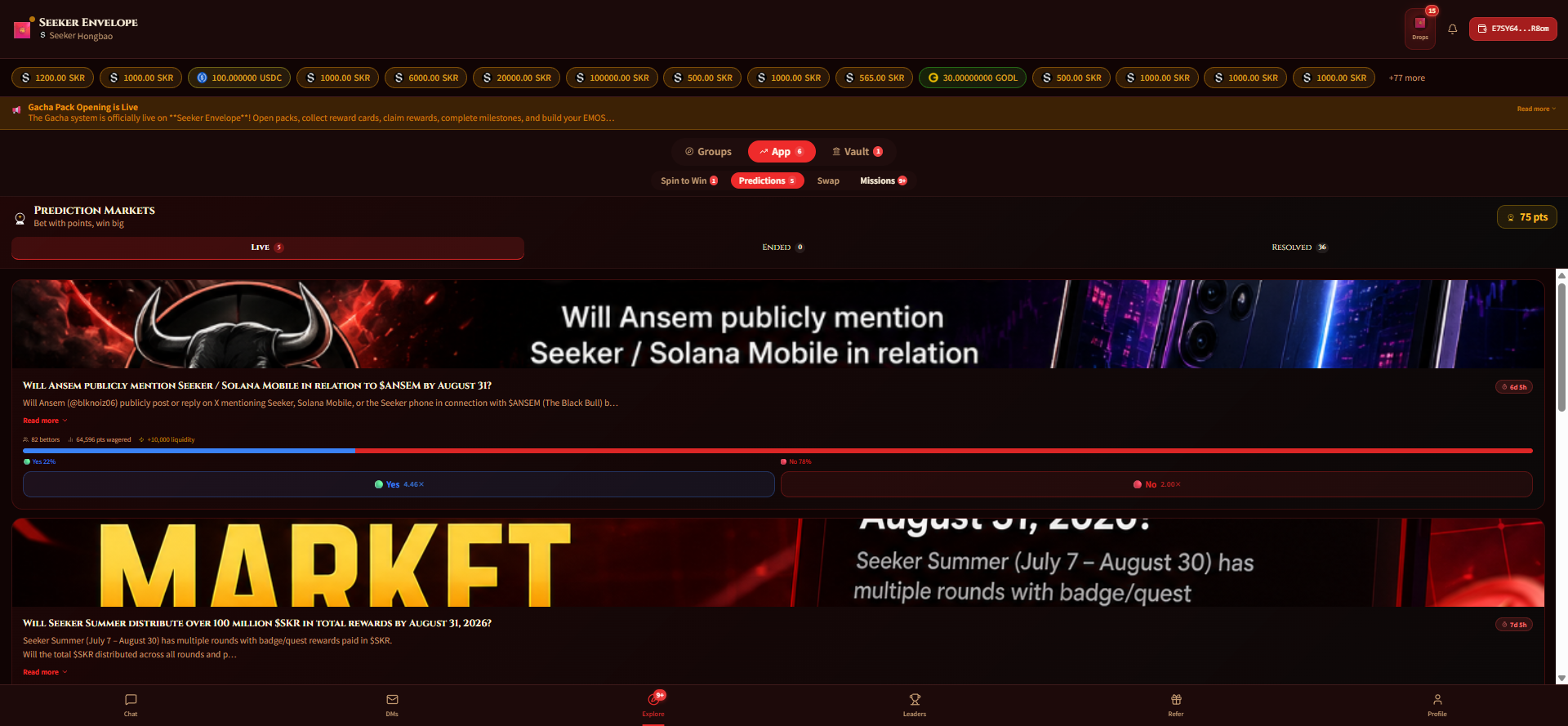
The interface labels this as betting with points. I expanded a market asking
whether a verified X account would publicly connect Seeker or Solana Mobile
with $ANSEM. Its criteria defined qualifying Yes and No outcomes, required a
publicly accessible post and allowed screenshots or archived links as evidence.
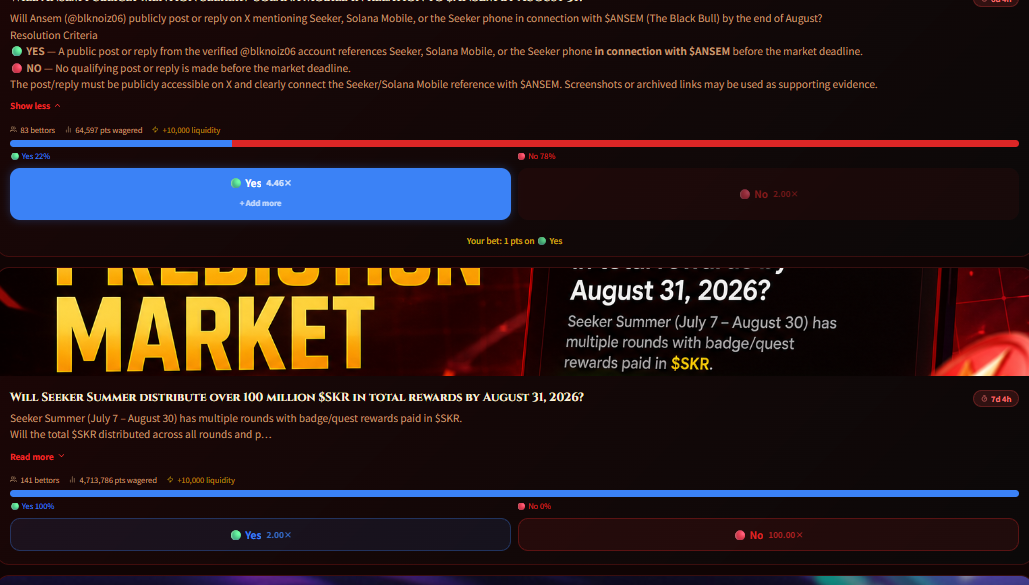
I entered the one-point minimum on Yes. Before submission, the panel showed my
75-point balance, a four-point potential payout and a 4.46× multiplier. The bet
completed without a wallet signature or asset movement; my balance fell to 74,
the market count rose to 83 bettors and the card displayed Your bet: 1 pts on Yes.
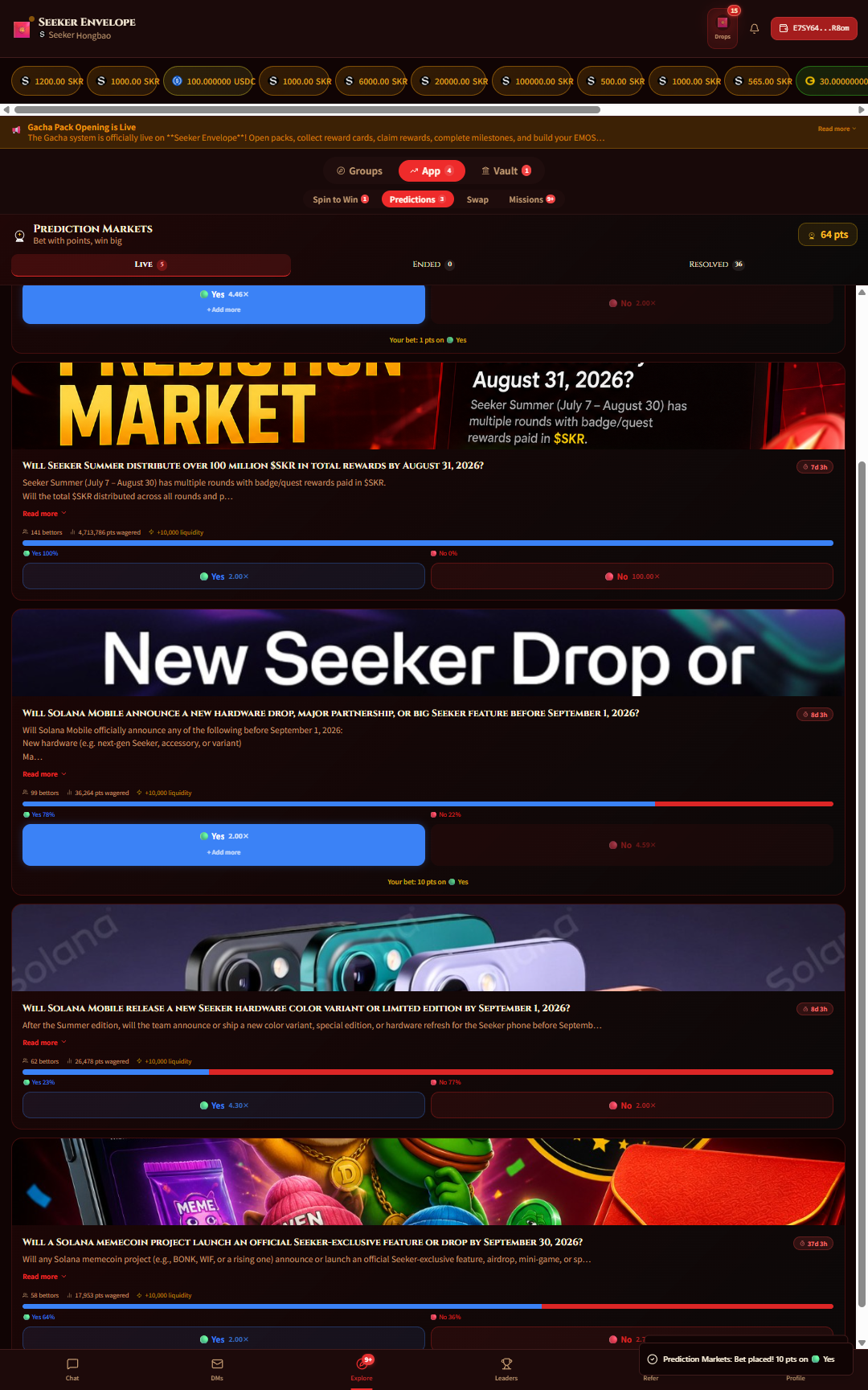
I then made a more representative 10-point test on a second market asking
whether Solana Mobile would announce new hardware, a major partnership or a
major Seeker feature before September 1. The preview showed a 20-point
potential payout at 2.00×. It again completed without a wallet signature: the
balance fell from 74 to 64, bettors rose from 98 to 99, wagered points rose from
36,254 to 36,264, and the card confirmed Your bet: 10 pts on Yes. Neither
entry completed a daily Mission.
This small test makes the use case less abstract: communities can forecast an ecosystem event and aggregate sentiment through a shared, auditable question. The account received these test points without a purchase, and neither entry asked for a wallet signature. That does not establish whether points can ever acquire economic value, nor does it prove eventual resolution and payout. Linking each resolved market to its evidence would make that final step easier to trust and audit.
Points, badges and staking
Points tie together several parts of the product: Missions award them, Prediction Markets use them and Spin to Win advertises possible point outcomes. The wheel displayed six possible results from 1,000 to 30,000 points. My first spin completed without a wallet signature and landed on 1,000 points. The result screen recorded one total spin, 1,000 points from spins and an approximately 84-hour wait until the next spin.
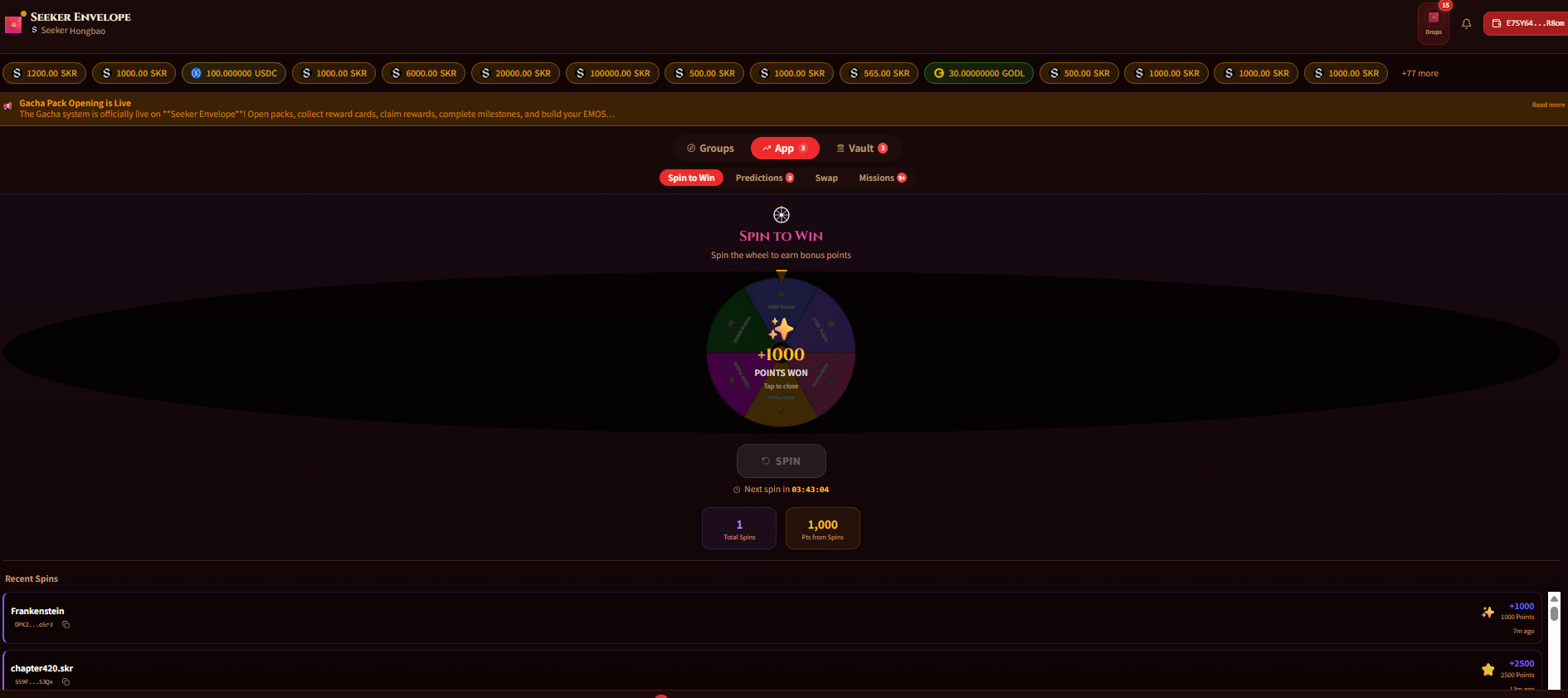
Profile then showed 1,064 available and 1,064 total earned—the exact arithmetic
of 75 starting points, minus 11 wagered, plus the 1,000-point spin result.
The Daily board separately offered 2,000 points for Spin the wheel on seeker envelope. Expanding it revealed that completion is not automatic: the user
must submit a screenshot as proof. At that point I hadn't submitted mine, so
zero points earned, zero of 19 missions completed and no submission history was
the expected state.
A different 20,000-point mission points to the mobile Seeker Wheel app and also
requires proof; the interface explicitly distinguishes that SKR-awarding app
from the points-only web wheel.
The receipt chain I used
I treated the account as a tiny state machine rather than trusting success toasts. These four checkpoints closed the loop:
| Checkpoint | Before | Action | Verifiable state after |
|---|---|---|---|
| Prediction 1 | 75 pts | 1 pt on Yes | 74 pts; card recorded Your bet: 1 pts on Yes |
| Prediction 2 | 74 pts | 10 pts on Yes | 64 pts; bettors 98→99; wagered 36,254→36,264 |
| Spin | 64 pts | One free spin | +1,000 pts; one total spin; ~84-hour cooldown |
| Profile | 64 + 1,000 | Open Profile | 1,064 available and 1,064 earned |
That gives a reproducible invariant:
75 - 1 - 10 + 1,000 = 1,064The
Profile receipt
closes it. The separate 2,000-point mission remains outside that equation
because its proof is still Pending.
For me, that separation is the product's most revealing design choice. My point is that the points loop is already auditable, while settlement and future rights still ask for trust. The real problem is not feature count; it is making every boundary inherit the same quality of receipt.
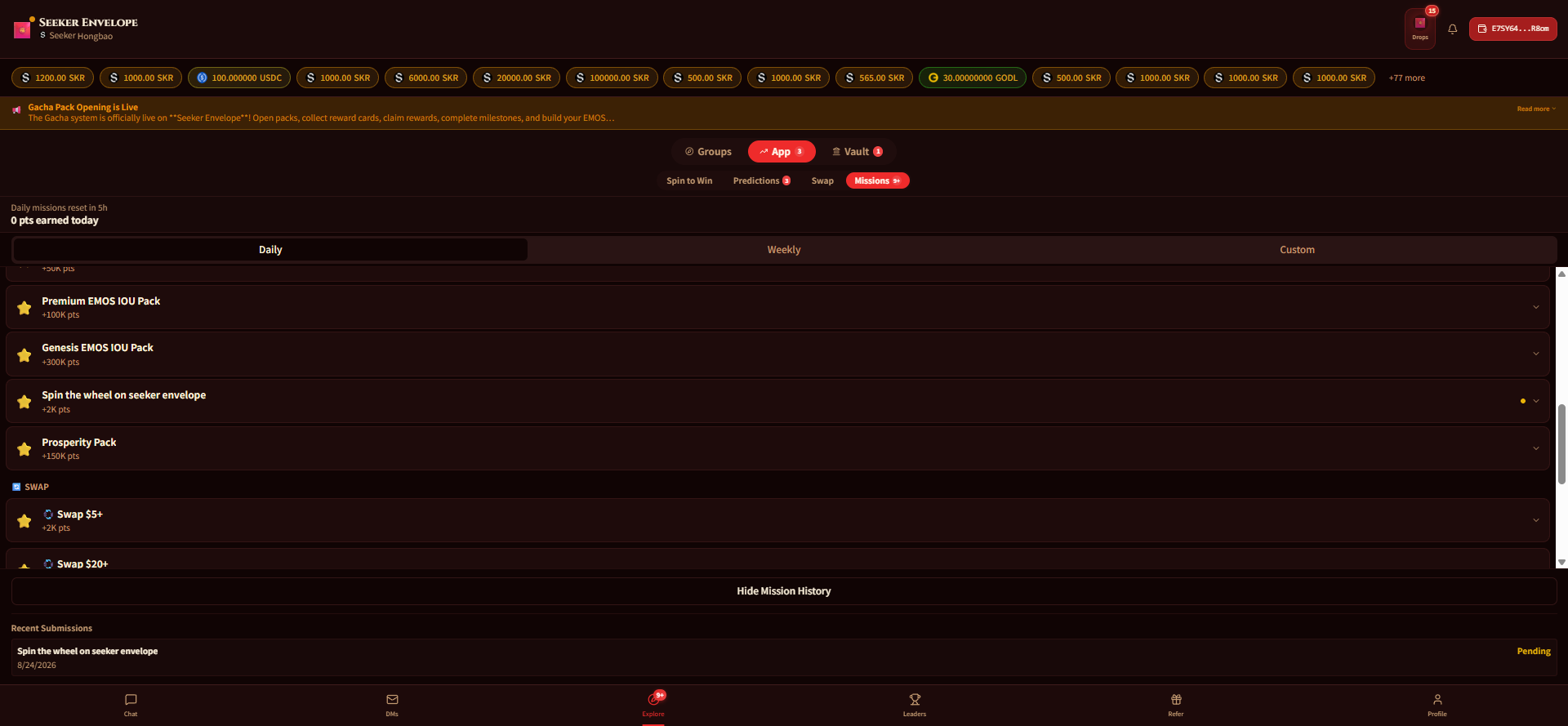
I subsequently submitted the spin screenshot. Mission History recorded the
entry as Pending on August 24; the board still showed zero points earned and
zero completed missions, so I treat the advertised 2,000-point reward as under
review rather than earned. This pending state is useful transparency, though a
visible review-time estimate would set expectations better.
Profile displays available, earned and redeemed points. It also showed redemption and staking options; I did not execute either or verify a payout.
Badges provide a longer-term identity layer. The visible streak ladder ran from a 30-day Bronze Flame to a 1,000-day Hall of Fame badge.
It is clearly designed to encourage retention, but the interface should explain the exact check-in rule and what happens when a streak breaks.
Gacha is a collection loop, not just a random reveal
The connected Vault makes the metagame concrete. Packs have a point cost, five-card contents, collection progress and a ten-opening milestone. The Standard EMOS IOU Pack was listed at 200,000 points, with an alternative 1 USDC payment in its contents panel. The contents panel listed tiers from Common through Legendary. Other packs advertised point, USDC, SOL or custom rewards, at very different costs.
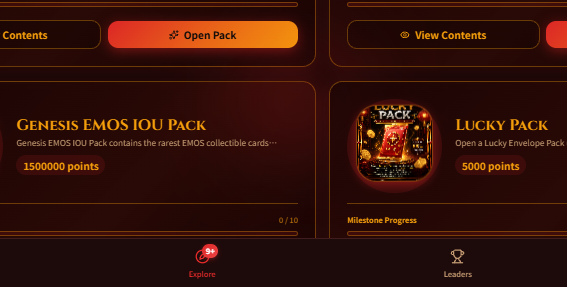
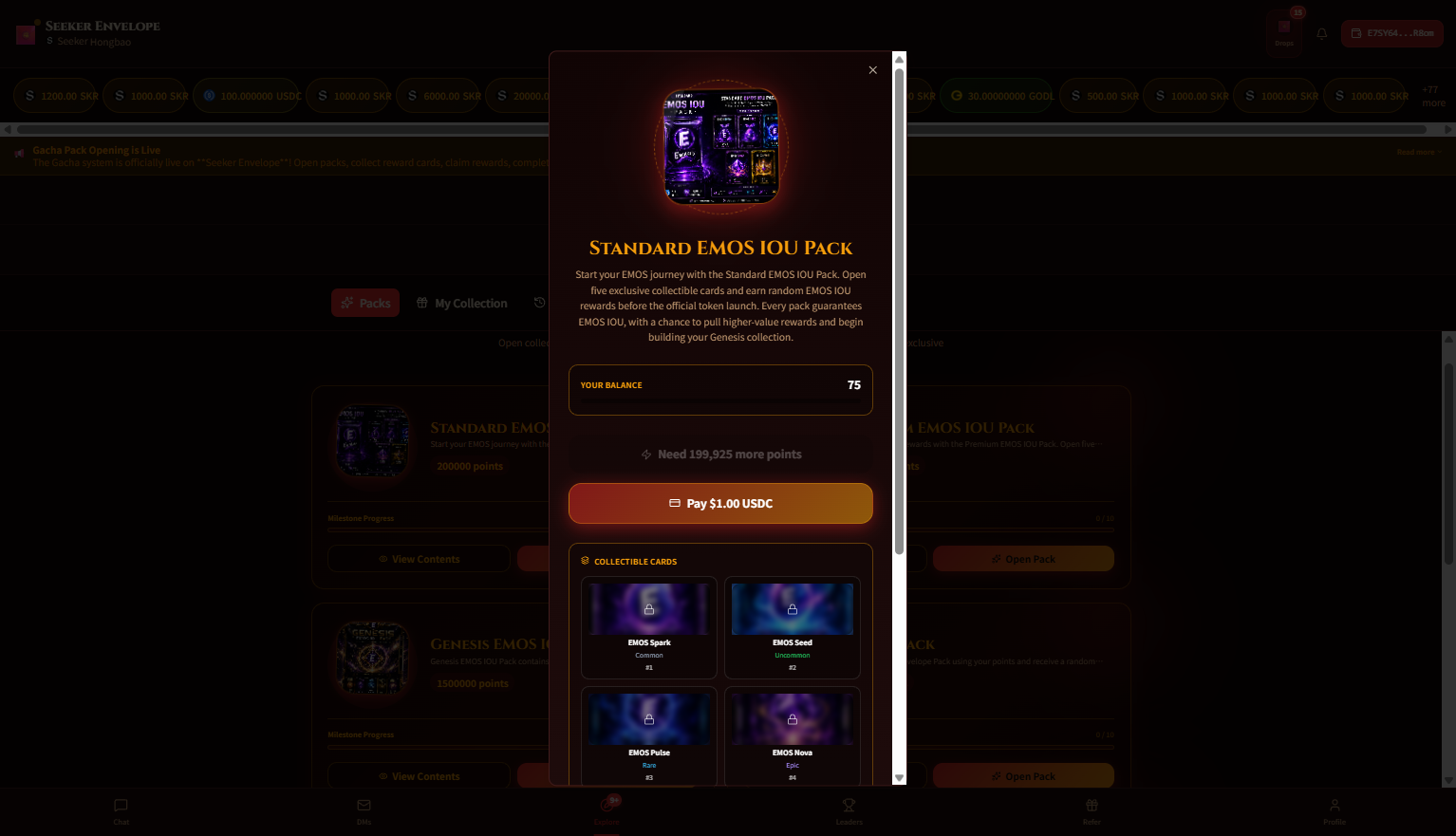
That collection layer extends beyond opening packs: Vault includes My Collection and Activity views, while Missions rewards pack activity. Together those mechanics create a repeat loop—earn points, choose a pack, fill a set, work toward milestones and potentially merge duplicates. I inspected the pack and contents screens but did not buy or open one, so I cannot verify draw odds or reward delivery from personal experience.
EMOS IOUs are not the same as EMOS
The EMOS issuer's litepaper describes an IOU as a collectible reward card found inside special Gacha packs. Each pack contains five cards, with possible common, rare, epic and legendary IOUs alongside community cards and bonus rewards.
The crucial distinction is timing: an EMOS IOU represents a future allocation. The issuer says eligible IOUs become redeemable for EMOS only after a future Token Generation Event. An IOU is not the currently delivered token, and eligibility still matters.
The issuer's published litepaper describes the IOU allocation, exhaustion rule and a future pre-TGE staking campaign. Those are forward-looking issuer claims, not independently verified guarantees.
The described model also carries the usual Gacha risk: opening another pack does not guarantee a desired rarity. Users should look for clear prices, probabilities, remaining allocation and redemption conditions before spending.
Official EMOS litepaper: https://emostically.com/p/emos.html
Governance is structured—and still evolving
Governance is more structured in the interface than the litepaper's future-facing language suggests. Vault displayed one point as one unit of voting power and a 50,000-point proposal threshold, with categories for product, community, ecosystem and partnership proposals.
The page displayed active and historical proposals with vote totals, quorum, time remaining and outcomes such as Passed, Failed and Implemented. The interface marked proposals for duplicate-card merging and a free Standard EMOS IOU Pack for Seeker Badge holders as Implemented.
The interface links feedback to visible product states. It does not prove decentralized control or treasury execution. The clearest improvement would be to link each implemented proposal to the resulting release, transaction or treasury record.
What works well
- Missions double as a map of the ecosystem rather than an isolated checklist.
- Swap and Prediction cards expose key information before an action.
- Badges and historical governance outcomes give participation continuity.
What I would improve
- Explain signatures, costs and asset movement before each action.
- Surface proof requirements on collapsed Mission cards, not only after expansion, and give submissions a clear pending/success/failed receipt.
- Publish Gacha probabilities and redemption conditions beside each pack.
- Link prediction resolutions and implemented proposals to reproducible sources.
- Distinguish loading, empty and disconnected states visually.
Final take
Seeker Envelope's strongest idea isn't a wheel, market, swap or pack. It's that each feature can feed the next one. Discovery becomes action; action becomes points; points become forecasts, collections or governance. That's a product system, not a feature list.
The connected experience is far more informative than the public shell, but it also reveals where users should slow down. A mission can encourage a swap; a Drop can require token ownership and public engagement; a pack can contain a future IOU rather than a current token. Those distinctions deserve to be part of onboarding, not footnotes discovered after the fact.
My test ended with a useful sequence: 75 free points, 11 wagered across two
markets, 1,000 won from one free spin, 1,064 confirmed in Profile, then a
screenshot submitted for a separate 2,000-point mission and recorded as
Pending. Every state change matched once I expanded the proof requirement.
No wallet signature appeared. No SOL or token moved.
Start with Explore. Expand every Mission. Open View Contents before buying a pack. Read a prediction's resolution criteria before wagering. At any point where the next click changes authority, assets or public identity, stop and measure the trade. If Seeker Envelope makes those boundaries as legible as its reward loop, the product won't just be engaging. It'll be easier to trust.
The app link above is official and contains no referral code. More of my work on systems and product boundaries is at juanchi.dev and GitHub.
Looking for this approach on your team?
Explore my technical case studies or discuss a senior role, architecture and technical leadership.
Comments (0)
What do you think of this?
Drop your comment in 10 seconds.
We only use your login to show your name and avatar. No spam.
No comments yet. Be the first — your take matters most when we're few.